

Australia’s 2026–27 Brown Marmorated Stink Bug (BMSB) season is now underway. From 1 September 2026 to 30 April 2027, the Department of Agriculture, Fisheries and Forestry (DAFF) applies seasonal measures to targeted goods manufactured in, or shipped from, target risk countries and shipped on board during this period.
In my experience working in customs and transport for more than 30 years, the most common mistake I see is treating BMSB as a last-minute customs formality. By the time cargo is at port, treatment capacity, documentation, vessel schedules and loading windows are already constrained. The businesses that avoid disruption are usually those that confirm the requirements before the shipment leaves its origin.
Why Australia takes a precautionary approach
Some importers view Australia’s BMSB measures as more restrictive than those applied in other markets. Compared with jurisdictions that rely more heavily on post-arrival intervention or risk-based sampling, Australia’s seasonal framework can require earlier planning, offshore treatment for certain high-risk cargo, and more detailed documentation before goods depart.
That can feel burdensome, particularly for businesses managing multiple origins, tight sailing schedules or seasonal inventory deadlines. However, the approach reflects Australia’s geographic isolation and its comparatively pest-free status across many agricultural and environmental systems.
BMSB is not a minor packaging issue. It is listed as a national priority plant pest because it can feed on more than 300 host plants, including fruit trees, vegetables, grains and ornamental plants. Unlike pests with a narrow host range, BMSB is highly mobile, can shelter in cargo and containers, and can establish across a wide range of environments.
Australia’s strategy is therefore deliberately precautionary. Rather than waiting for an established population to be detected, DAFF applies seasonal controls. This reduces the chance of an incursion becoming widespread and difficult to manage.
The commercial risk is also material. During 2024–25, DAFF recorded 219 BMSB detections, directed 2,859 consignments with a BMSB profile for inspection, and required 104 consignments to be exported after arriving non-compliant. A single non-compliant consignment can face inspection, treatment, export direction, storage, handling and rebooking costs - often at precisely the time when vessels, warehouses and transport capacity are under seasonal pressure.
In my view, the right response is not to argue against the controls, but to plan for them properly. When importers understand the rationale and build BMSB checks into their pre-shipment process, the requirements become manageable
What applies this season?
The 2026–27 measures apply to target high-risk and target-risk goods manufactured in, or shipped from, target risk countries. Target high-risk goods generally require mandatory treatment, while target-risk goods may be selected for random verification inspection.
The requirements also extend beyond the goods themselves. Vessels that berth, load or tranship goods from target risk countries during the season are subject to heightened surveillance.
A key change for 2026–27 is DAFF’s approval of Ethyl Formate as a BMSB treatment option for both offshore and onshore use, subject to the AusTreat framework.
The checks I recommend
Take it from my experience: the shipments that face the greatest BMSB disruption are usually those where compliance is considered too late. Before cargo leaves the country of export, I recommend importers confirm five things:
How technology supports compliance
Effective BMSB compliance depends on more than knowing the rules. It requires the right information to be visible at the right time, particularly the link between a shipment, its commercial documents, treatment evidence and customs requirements.
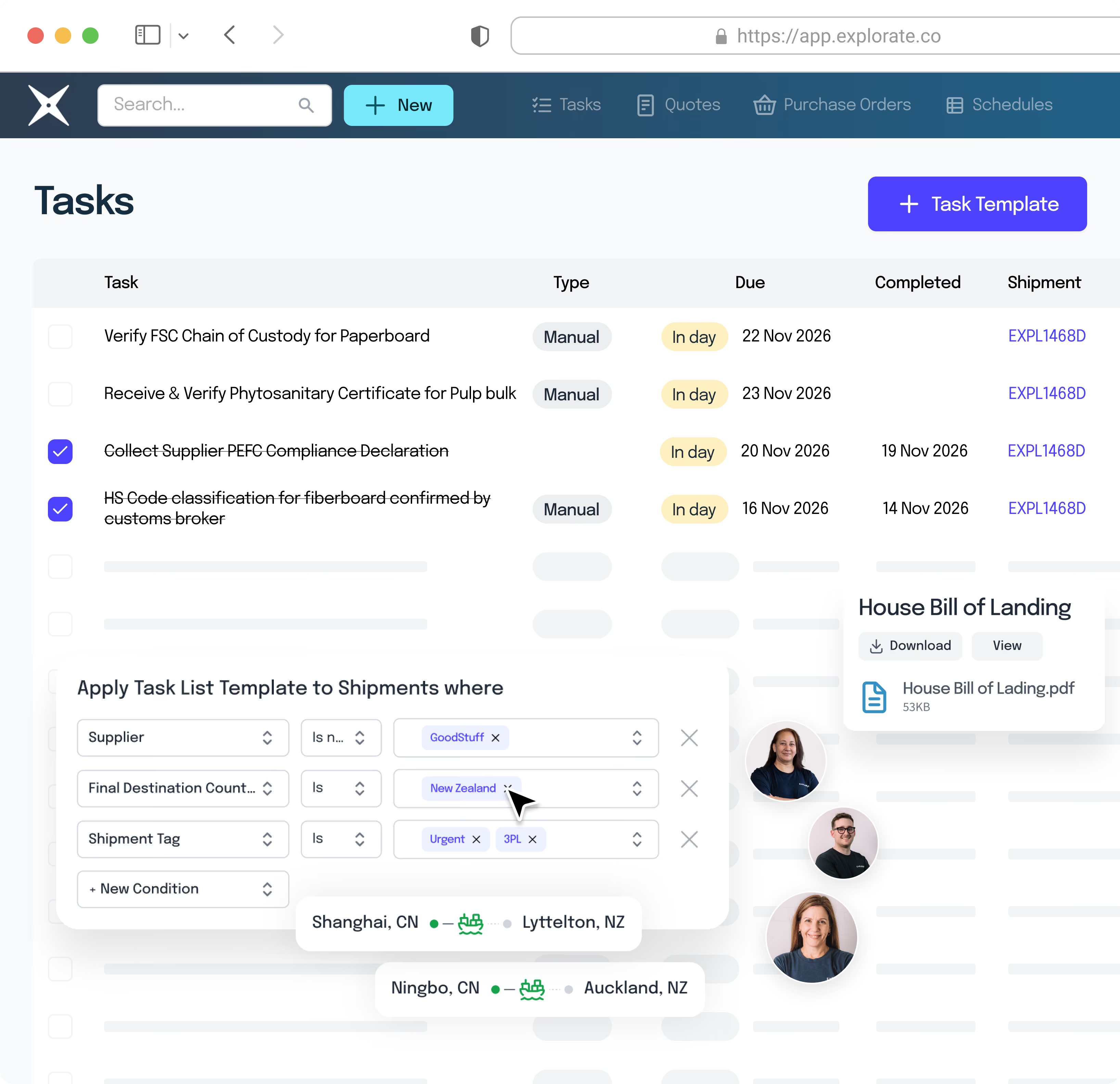
Explorate’s in-house Customs service is powered by technology to connect the freight we manage with the specific documents attached to it. This helps our team assess whether the applicable compliance requirements are in place, identify missing information earlier, and support a consistent compliance strategy across shipments.
For BMSB season, that means we can focus on the details that most often create risk: goods classification, country of manufacture or export, shipped-on-board dates, treatment documentation, container configuration and transhipment arrangements. By keeping shipment data and supporting documentation connected, we reduce the likelihood of compliance issues being discovered after cargo has already departed.
This approach also creates a clearer audit trail. When treatment certificates, shipping documents and customs information are aligned to the relevant consignment, importers and their customs representatives can respond more quickly if DAFF requests evidence or clarification.
The result is not simply faster clearance. It is greater confidence that each shipment has been assessed against the applicable requirements before it moves - and a stronger foundation for protecting delivery schedules, import budgets and customer commitments.
Why early planning protects margins
BMSB compliance is often discussed as a biosecurity obligation, but for importers it is also a margin-protection issue. Late identification of a treatment requirement can lead to missed vessels, additional storage, rehandling, emergency treatment and delayed delivery commitments.
The risk is particularly relevant during the Northern Hemisphere’s colder months, when BMSB can shelter in cargo, containers and protected spaces while seeking to overwinter. That is why DAFF’s seasonal measures align with the period when the pest is most likely to travel with imported goods.
To turn early planning into measurable operational improvement, I recommend tracking four KPIs:
My advice is simple: do not wait for the booking confirmation or arrival notice. Build the BMSB check into the pre-shipment process, involve your customs and freight representative early, and treat documentation as part of the operational plan, not an afterthought.

Licensed customs broker and trade expert with over 35 years of experience navigating Australian customs procedures and international customs clearance. Skilled in cross-border logistics, tariff classification, duty minimisation, and landside transport operations.
- Department of Agriculture, Fisheries and Forestry (DAFF). Seasonal measures for Brown marmorated stink bug (BMSB). Australian Government, 14 October 2026. Available at: https://www.agriculture.gov.au/biosecurity-trade/import/before/brown-marmorated-stink-bugs
- Department of Agriculture, Fisheries and Forestry (DAFF). 151-2026: Commencement of the 2026–27 Brown marmorated stink bug (BMSB) seasonal measures. Australian Government, 31 August 2026. Available at: https://www.agriculture.gov.au/biosecurity-trade/import/industry-advice/2026/151-2026
- Department of Agriculture, Fisheries and Forestry (DAFF). Goods subject to BMSB measures. Australian Government. Available at: https://www.agriculture.gov.au/sites/default/files/documents/factsheet3-goods-subject-to-bmsb-measures.pdf
- Department of Agriculture, Fisheries and Forestry (DAFF). AusTreat pre-border biosecurity treatment provider scheme. Australian Government, 15 September 2026. Available at: https://www.agriculture.gov.au/biosecurity-trade/import/before/prepare/treatment-outside-australia/AusTreat
- Department of Agriculture, Fisheries and Forestry (DAFF). Stink bugs. Australian Government, 28 March 2025. Available at: https://www.agriculture.gov.au/pests-diseases-weeds/plant/brown-marmorated-stink-bug
- Department of Agriculture, Fisheries and Forestry (DAFF). 2025–26 BMSB Seasonal Measures. Australian Government. Available at: https://www.agriculture.gov.au/sites/default/files/documents/2025-26-bmsb-industry-presentation.pdf
- Inspector-General of Biosecurity (IGB). Assessment of the effectiveness of biosecurity measures to manage the risks of brown marmorated stink bugs (BMSB) entering Australia. Australian Government. Available at: https://www.igb.gov.au/assessment-effectiveness-biosecurity-measures-manage-risks-brown-marmorated-stink-bugs-bmsb-entering-australia
Frequently Asked Questions
Explorate gives supply chain managers one real-time view across ever forwarder, lane and mode without replacing your current process, partners or systems.

